
Last chance to win this lovely painting ...
Farewell to Esmé Morris
 |
| Esmé Morris (right) with Luyanda Mjuleni on Meadowridge Common. |
It was very sad to hear of the passing of Esmé Morris earlier this month. Esmé was involved with the Friends of Meadowridge Common for many years and it was partially through her work on the Protea Atlas Project that the Common's Critically Endangered little Cape Flats Silky Puff (Diastella proteoides) was first noticed and the Common seen for what it is - a valuable remnant of Cape Flats Sand Fynbos. See article here. Esmé had a deep and prodigious knowledge of the Cape's extraordinary sand fynbos flora and fauna, having grown up on a farm in Philippi and maintained an interest in it all her life. She has contributed immensely to the conservation of Meadowridge Common over the years, and will be greatly missed.
Raffle and cakes

The Friends of Meadowridge Common are having a cake and plant sale at the Meadowridge Park and Shop Centre on Howard Ave, Meadowridge on Saturday 7 May from 9 till 10 am to raise funds for the conservation of the Common. This will also be the last chance to buy tickets for the raffle of the beautiful framed watercolour painting of the Common by artist Nicholas Walker. Tickets are R30 each. The draw will take place shortly after the cake sale, and the winner will be contacted by the Chairperson of the Friends.
Please visit the stand to buy tickets, goodies, or donate things to sell. There will be a lovely selection of locally indigenous, waterwise fynbos plants from the Fynboslife nursery to buy, as well as honey, cakes and muffins.
Join the City Nature Challenge 2022

The annual City Nature Challenge is coming up this weekend from Friday 29 April until Monday 2 May 2022. Cape Town has its title to defend so please join in the challenge and go out and enjoy our incredible biodiversity! Participating is easy. Click away in your backyard or join in one of the events The City of Cape Town has planned for those who would like to explore new places (click here for more information).
We hope that you will be recording and uploading the special plants and animals that occur on Meadowridge Common, and if you need any help or advice there are two events being held - The Common Challenge on Saturday 30 April from 9h30 to 12h00 with Caroline Voget from the Friends of Meadowridge Common who will be there to answer questions about what and how to upload, and the Meadowridge Meander on Sunday 1 May from 11h30 to 12h30, organized by Sihle Jonas, Ecological Management Unit, Recreation and Parks Department, City of Cape Town.
Be prepared:
1) Download the free iNaturalist app on your phone, available for Android and iPhone
2) Sign up to iNaturalist as an observer by creating an account
3) Get outside and use the iNaturalist app to record as many plants and animals that you can find in your nature reserves, suburbs, school grounds, houses and gardens over 4 days from Friday 29 April – Monday 2 May.For more information on the two Meadowridge Common events, email the Friends on MeadowridgeFriend@gmail.com.
For more information on general events, please contact Dr Eleanor Yeld Hutchings:
People and Conservation Coordinator: Biodiversity Management Branch – Environmental Management Department, Westlake Conservation Centre, Steenberg Drive, Tokai
Tel: 021 444 3989 | Cell: 082 590 5184 | Email: eleanor.hutchings@capetown.gov.za | Web: www.capetown.gov.za
People and Conservation Coordinator: Biodiversity Management Branch – Environmental Management Department, Westlake Conservation Centre, Steenberg Drive, Tokai
Tel: 021 444 3989 | Cell: 082 590 5184 | Email: eleanor.hutchings@capetown.gov.za | Web: www.capetown.gov.za
Annual General Meeting 2022

The Friends of Meadowridge Common will be holding their outdoor AGM at 10 am on Saturday 2 April at 5 Faraday Way, Meadowridge. After the business, a framed watercolour of the Common (above) painted by well-known local artist Nicholas Walker, will be raffled for funds. (Tickets cost R30 each and the raffle will run for a few weeks before the final draw takes place on the Common at the end of April during the iNaturalist City Nature Challenge.) A talk on iNaturalist and the City Nature Challenge will form part of the meeting. Tea will follow. Anyone is welcome to attend and new members are welcome to join the Friends.
AGENDA
1. Welcome & apologies
2. Confirmation of Minutes of 2021 AGM
3. Chairman’s Report
4. Botanical Report and iNaturalist
5. Financial Report
6. Election of office bearers.
7. Tea under the trees
The Friends of Meadowridge Common are CREWsing along
 |
| Citizen Scientist Fiona Watson, centre, has mapped the rare and special flora of Meadowridge Common since she moved to the area in the 1980s. Fiona has led several walks on the Common and is seen here showing off the Common's spectacular Dozen Capesray (Struthiola dodecandra) bush. |
South Africa has many botanically unique vegetation types, such as the impressively diverse fynbos, and the Cape Peninsula contains some of the rarest and most threatened fynbos plant species of all. Meadowridge Common is a small remnant of the lowland fynbos veld type known as Cape Flats Sand Fynbos (CFSF), which is the most threatened vegetation type within the City of Cape Town and is, therefore, high on the list of conservation priorities. The national conservation target of 30% (required to conserve 70% of CFSF plant species) is unattainable as only 10% of CFSF remains. It continues, however, to be highly threatened, mostly by invasive trees and grasses.
The Custodians of Rare and Endangered Wildflowers (CREW) is a conservation programme under the banner of the South African National Biodiversity Institute (SANBI) and the Botanical Society of South Africa (BotSoc). Their slogan is ‘Citizens monitoring and conserving our plants’ and the programme relies on volunteers from the public – citizen scientists – helping to collect information on South Africa’s plants, particularly those threatened with extinction. SANBI, on behalf of all South African citizens, is committed by law to safeguard South Africa’s biodiversity, and the work of the CREW Programme is vital in that it provides data for scientists to study, map and monitor our ecosystems; which then informs policy decisions that concern the protection of our biodiversity. CREW’s main work lies in organizing and capacitating groups of citizen scientist to monitor areas where plants are particularly at risk. Anyone can join a CREW group.
The Friends of Meadowridge Common endeavour to protect the Common’s Cape Flats Sand Fynbos in as many ways as possible, and will be working with CREW’s Cape Peninsula section led by Shandre Coutriers. We therefore appeal to all friends to participate by photographing fauna and flora on the Common and surrounding areas and uploading them onto the international citizen science website iNaturalist. CREW uses iNaturalist to collect and collate data. You don’t have to formally belong to a CREW group – anyone can download the free app on their smartphones or computers, register as a user, and start photographing and uploading plants. iNaturalist’s southern African portal is curated by scientists at SANBI (notably Dr Tony Rebelo), and all the data we upload is processed by them and is also available to anyone using the site for research purposes. It’s a great website – even for those of you who just need a gogga or a plant identified.
Meadowridge Common contains two Critically Engendered plants – the Peninsula Silkypuff (Diastella proteoides) and the Twotone Retro Capegorse (Aspalathus retroflexa subsp. bicolor). There are three species recorded as Endangered, five as Vulnerable, and four as Near Threatened. These plants were identified and recorded by residents living near the Common – notably Fiona Watson who singlehandedly and before the advent of digital photography – photographed and identified (with the help of SANBI’s herbarium staff) over 150 species, including several rarities. It’s now up to us to make sure these plants – and the animals and fungi that interact with or are dependent on them – survive into the future. Their progress or decline needs to be recorded and, if necessary, acted upon.
And its not just plants that we can identify
and monitor. Meadowridge Common has several wild honeybee nests which are of
interest to scientists as South Africa is a bee diversity hotspot and the study
of the habits of our fynbos-adapted bees can provide vital information in the
light of alarming reports of unprecedented global bee declines and loss of bee
species. Our observations of monkey beetles, important pollinators of many
fynbos plants, could provide information that could save species of plants and
their pollinators. There are frogs and birds and other animals – and
observations of fungi and algae and their little-known relationships with
plants could provide future scientists with valuable information. Literally,
every little thing counts!
iNaturalist
regularly stages events to encourage a bit of competitive uploading like the
City Nature Challenge that is held in April, and the Great Southern Bioblitz in
September. The next City Nature Challenge, which was won by Cape Town last
year, will take place from 29 April to 2 May. The Friends of Meadowridge Common
and CREW volunteers will be on the Common at various times during that period where
you can come and find out how to participate. Meanwhile, we will be posting some
information on our webpage, Facebook and Instagram to start preparing for the challenge.
The IUCN categories
The
International Union for Conservation of Nature (IUCN) Red List is a
comprehensive inventory which sets criteria to evaluate the extinction risk of
a range of biological species and subspecies.
There are nine IUCN Red List categories:
·
Extinct (EX) – No known individuals remaining
·
Extinct in the wild (EW) – Known only to survive in
captivity, or as a naturalised population outside its historic range
·
Critically endangered (CR) – Extremely high risk of
extinction in the wild
·
Endangered (EN) – High risk of extinction in the
wild
·
Vulnerable (VU) – High risk of endangerment in the
wild
·
Near threatened (NT) – Likely to become endangered
in the near future
·
Least concern (LC) – Lowest risk (does not qualify
for a more at-risk category; widespread and abundant taxa are included in this
category)
·
Data deficient (DD) – Not enough data to make an
assessment of its risk of extinction
·
Not evaluated (NE) – Has not yet been evaluated
against the criteria
For more information visit https://www.sanbi.org/skep/the-iucn-red-list-explained/
Information on fynbos is from the article Passive restoration of Critically Endangered Cape Flats Sand Fynbos at lower Tokai Park section of Table Mountain National Park, Cape Town by Megan Smith, Dr Alanna Rebelo and Dr Tony Rebelo, https://restory.co.za/2020/01/13/passive-restoration-of-critically-endangered-cape-flats-sand-fynbos-at-lower-tokai-park-section-of-table-mountain-national-park-cape-town/
Read CREW’s latest newsletter at https://www.sanbi.org/wp-content/uploads/2021/07/CREW-Newsletter-July-2021-Volume-17.pdf
Fire update
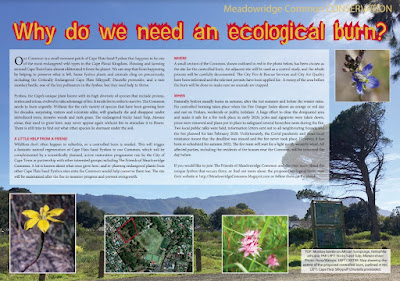
A poster has been created by the Friends of Meadowridge Common for display on the Common, to inform visitors about why this ecological intervention is vital for the health of the Common, and what progress has been made. It can be downloaded here.
The Constantiaberg Bulletin published an article on the proposed burn which can be read here.
Subscribe to:
Posts (Atom)