Showing posts with label Community Nest Spiders. Show all posts

Winter on the Common

Although all looks rather wintry and drab, some rain has fallen and things are starting to happen.
The Community Nest Spiders are hard at work building their nests - I counted four new ones in the vicinity of the Rehabilitation Area - this one in a Cluster Spiderhead (Serruria glomerata) bush.
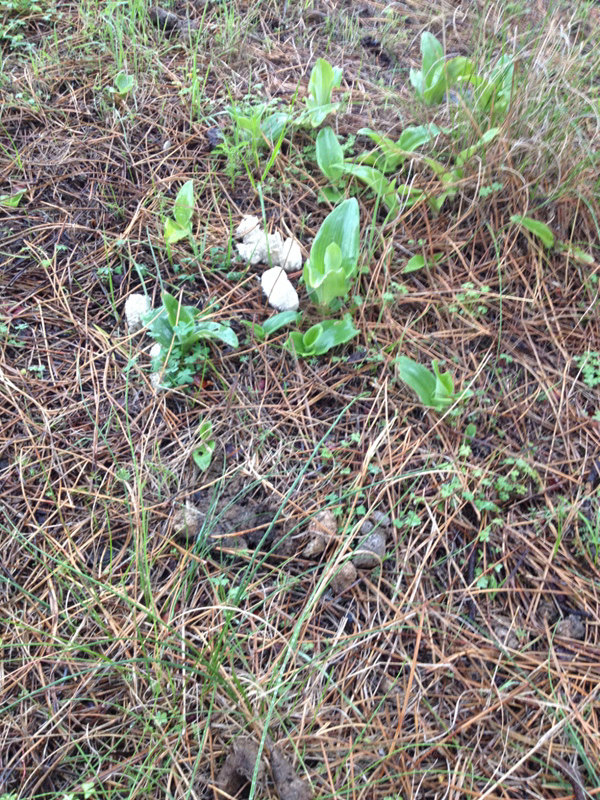
Dog poop continues to be a problem with dog owners not taking any responsibility for their dogs faeces that are festering all over the common. In this photo I counted seven separate piles in amongst the Green Satyr Orchids (Satyrium odorum) that are starting to come up now.
A budding Green Satyr Orchid.

Commonly known as Yellow Soldiers, this little Lachenalia reflexa is classified as Vulnerable on the Red List of South African Plants as it is "restricted to seasonally wet lowland soils and known from less than 10 locations. There is a continuing decline as a result of urban expansion, crop cultivation, livestock trampling and alien plant invasion."
 
What you can expect to see flowering on the Common in July
Babiana villosula
Lachenalia reflexa
Leucadendron salignum
Metalasia densa
Muraltia spinosa
Osteospermum moniliferum
Othonna filicaulis
Oxalis obtusa
Oxalis pes-caprae
Oxalis purpurea
Oxalis versicolor
Pauridia capensis
(formerly Spiloxene)
Serrurua glomerata
Struthiola ciliata
Zantedeschia aethiopica

Tortoise Berry (Muraltia spinosa or Nylandtia spinosa - the experts don't seem to be too sure on which to choose!)

And keep a lookout for the Black Sparrowhawk chicks in the tree near the Soccer Club building. Photo above by Margaret Macivor.

Community Nest Spiders

Adult spiders of most species are solitary and devote the greater part of their lives to catching prey, which can include prospective mates. Should the opportunity arise, they tend to eat mates, brothers, sisters, parents and young, leaving a single, fat, well-fed individual!
  Not all spiders are anti-social, though. Community nest spiders, in the genus Stegodyphus, such as Stegodyphus dumicola, are our only truly social spiders in South Africa. They live in communities, co-operating in prey capture and brood care. When a large insect lands in the web, it invites a heaving scrum of spiders, which eventually overpowers most insects. The nest - consisting of strong, hard, cardboard-like silk - starts off small but is enlarged as the colony grows. It has numerous holes and passageways. Large colonies can cover an entire tree in silk.
  For more info about the fascinating world of spiders, go to www.spiderclub.co.za, or buy Astri and John Leroy's book: Spiders of Southern Africa. To download a poster about the spiders on Meadowridge Common, click here.
Text: Helen Duigan and Astri Leroy
According to Astri Leroy, having this colony on the Common is really lucky as it is difficult to find them anywhere on the Cape Peninsula because Argentine ants are thought to have more or less wiped them out in greater Cape Town.

Photos: Caroline Voget. Meadowridge Common, August 2014.