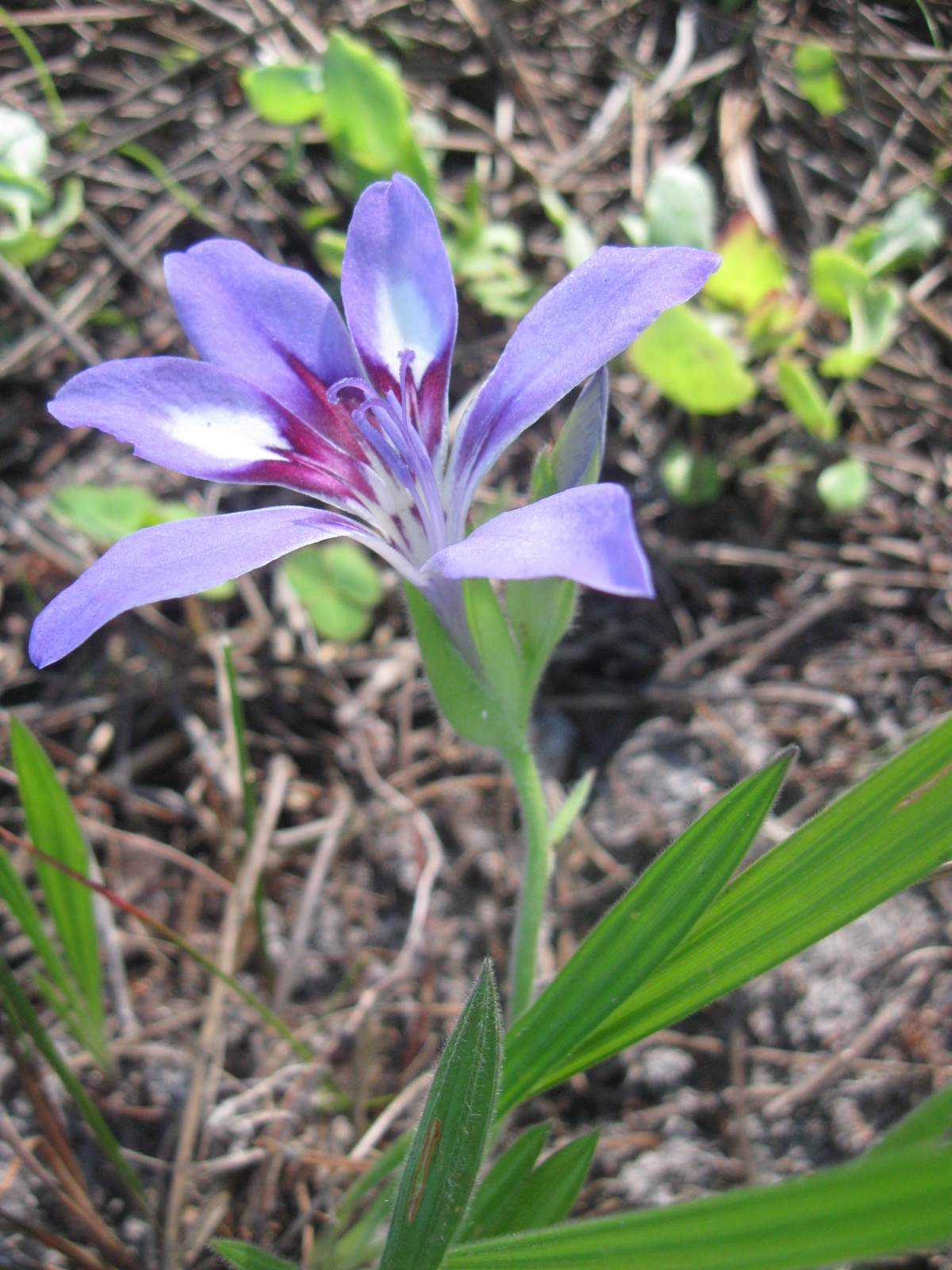
Spring flower walks on Meadowridge Common

Join Olwen Gibson, experienced tour guide leader, and the Friends of Meadowridge Common on two guided walks on the Common to view our special spring flowers.
The walks will take place on Saturday 15 September 2012 and Saturday 29 September 2012. Meet on the gravel road that leads off Faraday Way towards the soccer fields at 12h30. For a more detailed map, click here.
The walks are free, but non-members will be asked for a donation towards the Friends of Meadowridge Common.
For more information about the walks, please phone Fiona Watson at 021 712 0696.
Click here for more on what you might see on the Common in September.


Photo: Babiana ambigua.

Flowers of Meadowridge Common


The Friends of Meadowridge Common have published a set of four greeting cards to raise funds for the maintenance and rehabilitation of Meadowridge Common.
The cards feature paintings by botanical artist, Olwen Gibson, of four flowers that occur on the common: Pelargonium triste, Pelargonium cucullatum, Salvia chamelaeagnea and Wachendorfia paniculata. A pack of four cards costs R50 but Friends of Meadowridge Common only pay R40. Olwen Gibson is a member of the Botanical Artists Association of Southern Africa (BAASA) and is becoming quite well known for her meticulous and beautiful water colour paintings of our indigenous flora.
Your purchase will go towards the care of Meadowridge Common, which is a priceless remnant of the endangered vegetation type, Cape Flats Sand Fynbos. The Friends are a group of local residents who identified this precious remnant and made sure that it was added to the number of nature areas within the City of Cape Town’s biodiversity network.

If you would like to purchase a set of these cards, please phone Olwen Gibson at 021 712 1382 or email her at Meadowridgefriend@gmail.com.

The cards will be on sale before and after the talk on The lost fynbos of Tokai Park by Tony Rebelo which will be held in the Meadowridge Library on 12 September 2013 as well as before and after the spring walks that the Friends of Meadowridge Common will be hosting on Sat 15 and Sat 29 September.

AGM 2012


The AGM of the Friends of the Meadowridge Common was held on Monday 27 February and followed by an interesting talk by Ineke Moseley, a member of the team of photographers and botanists of the Friends of Silvermine who have photographed and documented the flora of Silvermine, entitled: “Flowers of the Southern Peninsula: rarities, endemics and pollination strategies”. Ineke and Corinne Merry gave a demonstration of their database of the flora of the Cape Peninsula, FloraDoc, which documents all the flora you are likely (and unlikely!) to come across on the Cape Peninsula - most of them accompanied by great photographs for easy identification. It is a great resource, and costs R150. For more information, click here.
One of the Friends of Meadowridge Common, Olwen Gibson, who is an accomplished botanical artist, exhibited a set of four beautiful paintings of flowers that occur on Meadowridge Common. These will soon be available as a set of four cards which will be available to Friends of Meadowridge Common at a special price. Email Meadowridgefriend@gmail.com for information about how to purchase a set of these lovely cards.

Rehabilitation on Meadowridge Common

Problems of conservation on the Common include:

1. Its small size accommodates a limited number of plants of some species, some numbers so low that extinction is a real possibility.

A remedy is to augment the number by propagating dicotyledons.
Using our plants we have propagated the following species:
Hermannia multiflora, Pelargonium cucullatum, Lampranthus reptans, Ruschia geminiflora, Lampranthus stenus, Salvia chamelaeagnea, Leucadendron salignum and Struthiola dodecandra.
We are grateful to Trevor Adams of Kirstenbosch and Maya Beukes for their help.
Photo above: The wetland in a wet winter by Fiona Watson.

2. When the Alphen retention ponds were dug to prevent flooding of the Diep River, the soil was dumped on the Common.
Maya Beukes provided a solution. In 2006 and 2008 she organized front end loaders to remove this soil and grass. The adjoining Meadowridge Football Club used this for their new fields and to construct a berm. The soil left behind was again at its original level. Seeds dormant and covered for 30 years germinated, covering the ground with Lobelia erinus, Monopsis debilis and Psoralea pinnata.
Maya also planted the species listed under number 1 in this area in different places and at different levels in order to establish their best niches for hot summers and winter flooding.
Other species previously found on the Common have been re-introduced using material growing locally to ensure that their DNA records are not compromised. Serruria glomerata (above) is doing well in the enclosed area. Athanasia dentata has found its niche in the far side of the lower non-enclosed area. It did not survive nearer the path.
F.J. Watson

Flowering on the Common in September

Hermannia multiflora


What you may see on a spring walk on Meadowridge Common this September.

Zantedeschia aethiopica Arum Lily – ARACEAE or Arum family.

Asparagus rubicundus Wag ’n bietjie – ASPARAGACEAE or Asparagus family.

Trachyandra ciliata Cape Spinach or Veldkool
Trachyandra revoluta – ASPHODELACEAE or Aloe family.

Colchium eucomoides which used to be Androcymbium eucomoides Men-in-a-boat
Baeometra uniflora Beetle Lily
Wurmbea monopetala – COLCHICACEAE or Colchicum family.

Wachendorfia paniculata Rooikanol – HAEMODORACEAE or Bloodroot family.

Albuca juncifolia (also known as Ornithogalum imbricatum) Cup and Saucer – HYACINTHACEAE or Hyacinth family.

Spiloxene capensis Peacock Flower – HYPOXIDACEAE or Star Lily family.

Geissorhiza aspera Blue Satinflower or Sysie
Geissorhiza imbricata
Moraea flaccida
Groottulp (with long, trailing leaf)
Moraea collina Geeltulp
Moraea tripetala Blou-uintjie
Romulea flava White Romulea orWitknikkertjie
Romulea hirsuta Frutang
Romulea obscura
Romulea rosea
Rooiknikkertjie or Common Romulea
Sparaxis bulbifera Fluweeltjie – IRIDACEAE or Iris family.

Triglochin bulbosa – JUNCAGINACEAE or

Satyrium odorum ORCHIDACEAE or Orchid family

Restio quinquefarius
Thamnochortus fruticosus
RESTIONACEAE or Restio family

Carpobrotus edulus
Lampranthus glaucus
Lampranthus reptans
Lampranthus stenus
Tetragonia fructicosa
– AIZOACEAE or Ice-plant family

Arctotheca calendula Cape Weed
Chrysanthemoides monilifera
Senecio littoreus
Cotula turbinata
Tripteris clandestina
Ursinia anthemoides
Dimorphotheca pluvialis
ASTERACEAE – Daisy family

Heliophila africana BRASSICACEAE – Mustard family

Psoralea pinnata FABACEAE – Pea family

Geranium incanum
Pelargonium capitatum
Pelargonium myrrhifolium
Pelargonium triste
GERANIACEAE – Geranium family

Hermannia multiflora MALVACEAE – Hibiscus family

Oxalis obtusa
Oxalis pes-caprae
Oxalis versicolor
OXALIDACEAE – Oxalis family

Nylandtia spinosa – POLYGALACEAE – Polygala family

Diastella proteoides
Leucadendron salignum
Protea repens
Serruria glomerata
PROTEACEAE – Protea family

Passerina corymbosa
Struthiola ciliata
Struthiola dodecandra
THYMELACEAE – Daphne family


List compiled by Fiona Watson, Botanical Officer, Friends of Meadowridge Common.

Garden plants that grow naturally on sandy flats

To download a list of indigenous plants that grow naturally on sandy flats, drawn up by Alice Notten - click here.
See the following post for a summary of Alice's informative talk.

Waterwise indigenous gardening on the sandy flats

Alice Notten, Chief Interpretive Officer at Kirstenbosch National Botanical Garden, gave an entertaining and informative talk on Waterwise indigenous gardening on the sandy flats. The talk was hosted by the Friends of Meadowridge Common, and took place in the Meadowridge Library - one of several interesting talks hosted by the Friends over the years. Alice Notten is a botanist and horticulturist who has worked at Kirstenbosch for many years, and is known by many for her interesting articles on gardening with indigenous plants on the website PlantZafrica as well as those in Veld & Flora. This is a summary of her talk, with links to the PlantZafrica site, where you can obtain more information on gardening with specific plant mentioned.
When Alice bought a house in Plumstead, she was a bit shocked at the windy, sandy conditions she faced as she had only had experience gardening in the rich, loamy soils of Johannesburg, and then the rich loamy soils of Kirstenbosch where she had lived up to this point. Anyone who has gardened in this area knows the type of soil that she was confronted with: sandy, oily soil that repels water. Alice started off by planting a windbreak around the perimeter, finding Searsia (Rhus) pendulina to be the most successful fast-growing, bushy hedge,
as well as the pioneer Keruboom (Virgilia divaricata and V. oroboides). This is an excellent pioneer tree that will act as a "nursery species" by providing protection for slower growing, more sensitive plants that you can plant around it. Being a pioneer species, the Keurboom will die in about ten to fifteen years by which time the slower growing species will be well established.
Another good hedge plant is Tecoma capensis. It is hardy and colourful and fast growing.