Birds and beetles

A Hairy Darkling Beetle (Lagria sp.) on the Common. According to the Field guide to Insects of South Africa by Mike Picker, Alan Weaving and Charles Griffiths, they are related to the toktokkes, the Tenebrionidae family.
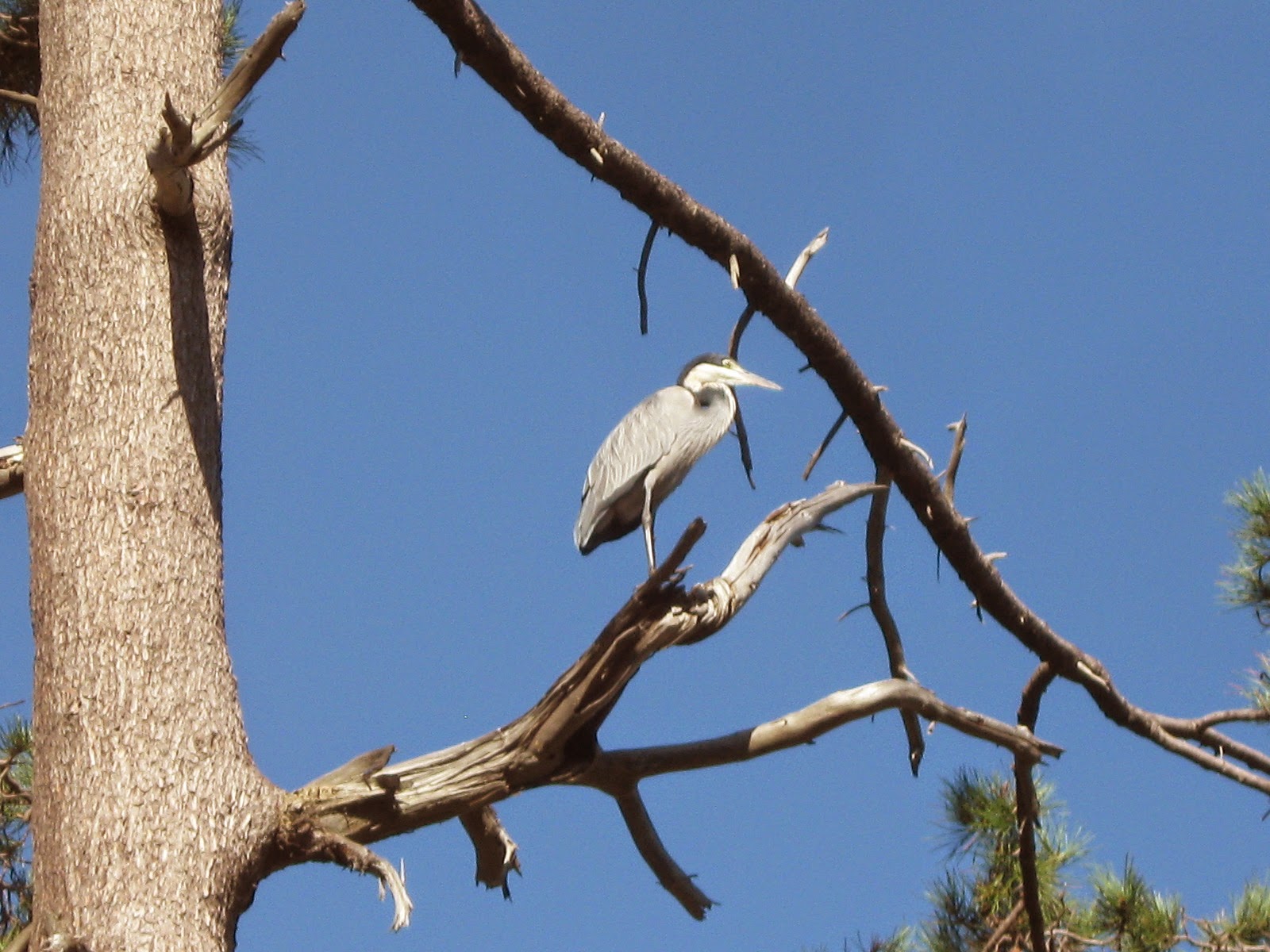
BELOW: A beautiful Black-headed Heron in a tall pine tree, trying to look like one of the branches.

iSpotting on the Common

We now have a special iSpot Project in which to group all the observations of wildlife and wildflowers on Meadowridge Common. Everything that is posted on iSpot from in and around Meadowridge Common will be added to the project as long as certain tags are put in when the observation is posted. The tags are "Meadowridge Common", "Cape Flats Sand Fynbos remnant" or "Meadowridge indigenous verge flora". To get there, click here.
To learn more about iSpot, click here.

Community Nest Spiders

Adult spiders of most species are solitary and devote the greater part of their lives to catching prey, which can include prospective mates. Should the opportunity arise, they tend to eat mates, brothers, sisters, parents and young, leaving a single, fat, well-fed individual!
  Not all spiders are anti-social, though. Community nest spiders, in the genus Stegodyphus, such as Stegodyphus dumicola, are our only truly social spiders in South Africa. They live in communities, co-operating in prey capture and brood care. When a large insect lands in the web, it invites a heaving scrum of spiders, which eventually overpowers most insects. The nest - consisting of strong, hard, cardboard-like silk - starts off small but is enlarged as the colony grows. It has numerous holes and passageways. Large colonies can cover an entire tree in silk.
  For more info about the fascinating world of spiders, go to www.spiderclub.co.za, or buy Astri and John Leroy's book: Spiders of Southern Africa. To download a poster about the spiders on Meadowridge Common, click here.
Text: Helen Duigan and Astri Leroy
According to Astri Leroy, having this colony on the Common is really lucky as it is difficult to find them anywhere on the Cape Peninsula because Argentine ants are thought to have more or less wiped them out in greater Cape Town.

Photos: Caroline Voget. Meadowridge Common, August 2014.

Banded Garden Orb-web Spider

Banded Garden Orb-web Spider (Argiope trifasciata).

This beautiful spider belongs to the Araneidae family of spiders. Argiope is one of the most familiar genera of orb-web spiders. Being diurnal, garden spiders are colourfully marked, the carapace silver and the legs banded. The aposematic (warning) yellow and black colouration of the abdomen remind birds that they are unpalatable. The Argiope web normally has two zig-zag bands of silk radiating outwards from the hub (centre) to the bottom corners of the web. There may be four of these bands in some species while some juveniles may construct a spiral. These are called “stabilimenta” and serve various functions: they stabilize and strengthen the web, make the web visible perhaps serving as a decoy for birds, or also to reflect ultraviolet light thereby deceiving and attracting insects.
Text: Norman Larsen. 
To download an A3 sized poster on the spiders of Meadowridge Common, click here.

Fire on Table Mountain

Two views of the fire in the Silvermine and Tokai areas of Table Mountain last week. Taken from Meadowridge Common. 

How you can join the CREW and learn more about our rare and endangered plants

The Friends of Meadowridge Common will be holding their AGM for 2015 on Wednesday 25 February in the community hall of the Meadowridge Library (click here for map) at 7h30 pm. The guest speaker will be Ismail Ebrahim of the South African National Biodiversity Institute's Custodians of Rare and Endangered Wildflowers (CREW) programme. CREW involves volunteers from the public in the monitoring and conservation of South Africa's threatened plants. Anyone can get involved - and CREW provides general plant identification courses as well as field training - so come along to the AGM and find out more. The programme is a partnership between SANBI and the Botanical Society of South Africa (BotSoc). For more information on CREW, click here.
Meadowridge Common has many of its own rare and endangered plants, and Fiona Watson, the Friend's Botanical Officer, will also be giving an update on the flora of Meadowridge Common.
Refreshments will be served and secure parking provided.
Please phone Fiona Watson at 021 712 0696 for more information.   
The Flats Silkypuff, (Diastella proteoides) on Meadowridge Common. This species was probably common and widespread, but it is now restricted to a few remnant patches of lowland fynbos. See Red List.

Meadowridge Common Bird List

Black-headed Heron

African Dusky Flycatcher Muscicapa adusta

African Goshawk Accipiter tachiro

African Harrier Hawk (Gymnogene) Polyboroides typus

Black Kite Milvus migrans

Black Sparrowhawk Accipiter melanoleucus

Black-headed Heron Ardea melanocephala

Bokmakierie Telophorus zeylonus

Cape Bulbul Pycnonotus capensis

Cape Canary Serinus canicollis

Cape Turtle Dove/Ring-necked dove Streptopelia capicola

Cape White-eye Zosterops virens

Cattle Egret Bubulcus ibis

Common Chaffinch Fringilla coelebs

Common Fiscal Lanius collaris

Common (European) Starling Sturnus vulgaris

Egyptian Goose Alopochen aegyptiaca

Hadeda Ibis Bostrychia hagedash

Fork-tailed Drongo Dicrurus adsimilis ssp. adsimilis

Hartlaub’s Gull Chroicocephalus hartlaubii

Helmeted Guineafowl Numida meleagris

Klaas's Cuckoo Chrysococcyx klaas

Laughing Dove Spilopelia senegalensis

Little Swift Apus affinis

Olive Thrush Turdus olivaceus

Peregrine Falcon Falco peregrinus

Pied Crow Corvus albus

Red-eyed Dove Streptopelia semitorquata

Red-winged Starling Onychognathus morio

Rufous-breasted Sparrowhawk Accipiter rufiventris

Sacred Ibis Threskiornis aethiopicus

Southern Double-collared Sunbird Cinnyris chalybeus             

Speckled Pigeon Columba guinea

Spotted Thick-knee (Dikkop) Burhinus capensis

Spotted Eagle Owl Bubo africanus

Swee Waxbill Coccopygia melanotis

White-backed Mousebird Colius colius

White-necked Raven Corvus albicollis

Yellow-billed Kite Milvus aegyptius

Help us grow this list. Share your bird-sightings on the Common on iNaturalist or contact the Friends of Meadowridge Common at Meadowridgefriend@gmail.com.