Showing posts with label Flowers on the Common. Show all posts

Winter on the Common

Although all looks rather wintry and drab, some rain has fallen and things are starting to happen.
The Community Nest Spiders are hard at work building their nests - I counted four new ones in the vicinity of the Rehabilitation Area - this one in a Cluster Spiderhead (Serruria glomerata) bush.
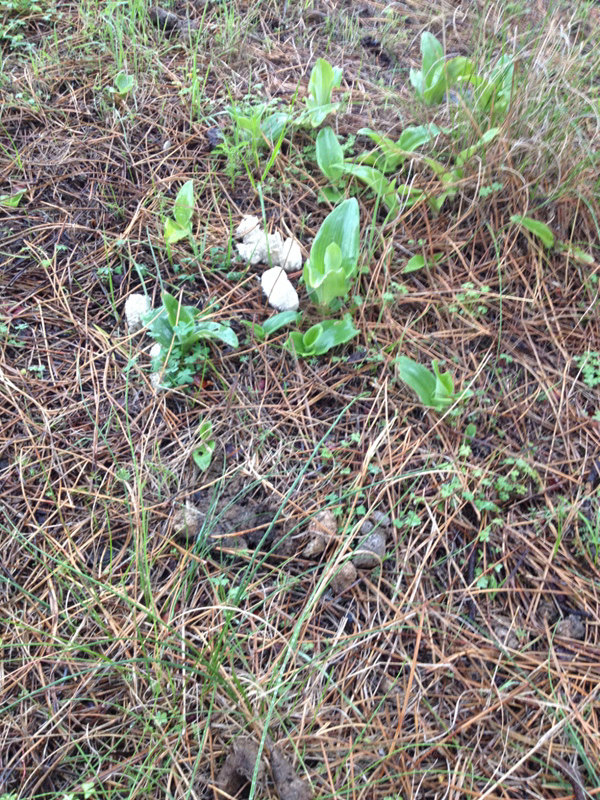
Dog poop continues to be a problem with dog owners not taking any responsibility for their dogs faeces that are festering all over the common. In this photo I counted seven separate piles in amongst the Green Satyr Orchids (Satyrium odorum) that are starting to come up now.
A budding Green Satyr Orchid.

Commonly known as Yellow Soldiers, this little Lachenalia reflexa is classified as Vulnerable on the Red List of South African Plants as it is "restricted to seasonally wet lowland soils and known from less than 10 locations. There is a continuing decline as a result of urban expansion, crop cultivation, livestock trampling and alien plant invasion."
 
What you can expect to see flowering on the Common in July
Babiana villosula
Lachenalia reflexa
Leucadendron salignum
Metalasia densa
Muraltia spinosa
Osteospermum moniliferum
Othonna filicaulis
Oxalis obtusa
Oxalis pes-caprae
Oxalis purpurea
Oxalis versicolor
Pauridia capensis
(formerly Spiloxene)
Serrurua glomerata
Struthiola ciliata
Zantedeschia aethiopica

Tortoise Berry (Muraltia spinosa or Nylandtia spinosa - the experts don't seem to be too sure on which to choose!)

And keep a lookout for the Black Sparrowhawk chicks in the tree near the Soccer Club building. Photo above by Margaret Macivor.

A winter visit to the Common

The rehabilitated wetland area. Blombos (Metalasia densa) growing on the left.
Sacred Ibis and Cattle Egrets on the flooded soccer fields.
The Cluster Spiderhead (Serrurua glomerata) growing in the rehabilitated wetland area.

Other flowers you can expect to find on the Common in June are Ploegtydblommetjie (Empodium plicatum), Bietou (Chrysanthemoides monilifera), Ganskos (Cotula turbinata) and  Yellow Sorrel (Oxalis pes-caprae). 

Summer on Meadowridge Common

Although it doesn't look very colourful in summer, the Common is full of surprises.
You can find butterflies like this Painted Lady (Vanessa* cardui).
Or the beautiful blue pea-flowers of the Fountain Bush (Psoralea pinnata).
The Sweet Sprayflower or Heuningblommetjie (Struthiola dodecandra) flowers from November to March.
And there is always a pelargonium in bloom. This one is the Wild Storksbill (Pelargonium cucullatum subsp. cucullatum).
*Sometimes also called Cynthia cardui (see http://www.ispot.org.za/node/152867#comment-48640).

Flowering on the Common in September

Hermannia multiflora


What you may see on a spring walk on Meadowridge Common this September.

Zantedeschia aethiopica Arum Lily – ARACEAE or Arum family.

Asparagus rubicundus Wag ’n bietjie – ASPARAGACEAE or Asparagus family.

Trachyandra ciliata Cape Spinach or Veldkool
Trachyandra revoluta – ASPHODELACEAE or Aloe family.

Colchium eucomoides which used to be Androcymbium eucomoides Men-in-a-boat
Baeometra uniflora Beetle Lily
Wurmbea monopetala – COLCHICACEAE or Colchicum family.

Wachendorfia paniculata Rooikanol – HAEMODORACEAE or Bloodroot family.

Albuca juncifolia (also known as Ornithogalum imbricatum) Cup and Saucer – HYACINTHACEAE or Hyacinth family.

Spiloxene capensis Peacock Flower – HYPOXIDACEAE or Star Lily family.

Geissorhiza aspera Blue Satinflower or Sysie
Geissorhiza imbricata
Moraea flaccida
Groottulp (with long, trailing leaf)
Moraea collina Geeltulp
Moraea tripetala Blou-uintjie
Romulea flava White Romulea orWitknikkertjie
Romulea hirsuta Frutang
Romulea obscura
Romulea rosea
Rooiknikkertjie or Common Romulea
Sparaxis bulbifera Fluweeltjie – IRIDACEAE or Iris family.

Triglochin bulbosa – JUNCAGINACEAE or

Satyrium odorum ORCHIDACEAE or Orchid family

Restio quinquefarius
Thamnochortus fruticosus
RESTIONACEAE or Restio family

Carpobrotus edulus
Lampranthus glaucus
Lampranthus reptans
Lampranthus stenus
Tetragonia fructicosa
– AIZOACEAE or Ice-plant family

Arctotheca calendula Cape Weed
Chrysanthemoides monilifera
Senecio littoreus
Cotula turbinata
Tripteris clandestina
Ursinia anthemoides
Dimorphotheca pluvialis
ASTERACEAE – Daisy family

Heliophila africana BRASSICACEAE – Mustard family

Psoralea pinnata FABACEAE – Pea family

Geranium incanum
Pelargonium capitatum
Pelargonium myrrhifolium
Pelargonium triste
GERANIACEAE – Geranium family

Hermannia multiflora MALVACEAE – Hibiscus family

Oxalis obtusa
Oxalis pes-caprae
Oxalis versicolor
OXALIDACEAE – Oxalis family

Nylandtia spinosa – POLYGALACEAE – Polygala family

Diastella proteoides
Leucadendron salignum
Protea repens
Serruria glomerata
PROTEACEAE – Protea family

Passerina corymbosa
Struthiola ciliata
Struthiola dodecandra
THYMELACEAE – Daphne family


List compiled by Fiona Watson, Botanical Officer, Friends of Meadowridge Common.

A summer stroll

Take a stroll on the Common and although it looks hot and dry, you will be amazed at what you find. One of the storyboards has a display of the flowers you might come across ... Erica subdivaricata is just starting to flower ... and the Sour Fig (Carpobrotus edulis) flowers are opening too.
This beautiful little aristea, Aristea dichotoma, was flowering resolutely in the hot sun. It was identified by Fiona Watson and she observes that it seems to prefer to grow where it gets some shade. The leaves are tough, narrow and point vertically upwards to avoid direct sunlight. In this photo you can see the three-winged fruit.
The Common Sugarbush (Protea repens) was flowering too, and was covered in honeybees. Strictly speaking, this particular bush was planted here, but it might well have occurred here naturally in days gone by. Come along to the AGM on Monday 28 February, to find out more about the flowers of Meadowridge Common and the fascination of bees. These butterfly flowers are definitely not indignous. They are Gaura lindheimeri and hail from Texas and Louisiana.
You will notice lots of snails in the low shrubs on the Common. These are introduced snails - snailiens - that have become a bit of a pest in the Cape. More about them here.

Jumping-ball Moths and the Glossy Wild-currant

Glossy Wild-currant, Shiny-leaved Rhus, Blinktaaibos
Searsia lucida (formerly Rhus lucuda) ANACARDACEAE (the mango family)
At the moment the fruits on the Glossy Wild-currant can be seen on the Common.
A fascinating insect-plant relationship plays itself out with the Glossy Wild-currant Rhus lucida and the Jumping Gall Moth Scyrotis athleta. In the sand and leaf-litter beneath Searsia lucida one can sometimes see small (about 6 mm) oval balls that jump. In the ball is the larva of a moth, Scyrotis athleta (family Cecidosidae). The movement and jumping is a response to heat and facilitates repositioning of the ball into ideal pupating conditions in the soil and leaf-litter. It is quite a mystery how such a small larva in such a confined space is able to exert the force required to jump (up to 10 cm). Janse (1920) concluded that it is done by careful positioning inside the ball and rapid contracting and relaxing of muscles.
The balls start off as bumps (galls) that form on the leaves of Searsia lucida. A female moth lays her egg probably by inserting her ovipositor into the leaf. The gall is formed around the hatched larva possibly as a result of the feeding action inside the leaf. This is still being investigated. The larva feeds inside the gall and when mature the external layer of the gall bursts open and the ball falls to the ground. Jumping can continue for up to 6 weeks and the moth emerges a few months later. (Information and more photos on the website biodiversityexplorer.)

Erica subdivaricata


Erica subdivaricata ERICACEAE (erica family)

This beautiful erica grows up to 1 m and has small, bell-shaped, white (sometimes just tinged with pale pink) flowers that come out from January on the Common. It occurs on lower slopes and flats in the south-western Cape, the Agulhas Plain and from Malmesbury to Bredasdorp, seeming to prefer slightly damp, partially shady spots.

It flowers in March on the Common.


Rough Blue Sage

Rough Blue Sage, Bloublomsalie, Salvia chamelaeagnea LAMIACEAE (the mint and sage family)

This pretty plant is flowering on the Common now. It differs from the other blue Wild Sage or Bloublomsalie, Salvia africana-caerulea, in that its calyx does not enlarge in the fruiting stage. It flowers from November to April.

Tips for growing the Rough Blue Sage
Liesl van der Walt of Kirstenbosch says, "The blue Salvia chamelaeagnea looks beautiful when flowering with blue agapanthus. The white form looks lovely mixed with other green foliage plants, giving the garden a fresh and cool look during the midsummer heat. Plants can be maintained in the garden for several years, but need to be cut back after flowering to keep them tidy and vigorous." (See Plantzafrica.)

A spiny bear's foot on the Common?

You often see these flat, prickly leaves in the middle of the paths on Meadowridge Common. Have you ever stopped to wonder what they are? It is a platdoring, or Arctopus echinatus.
In Greek, arktos is "bear", and pous is "foot" (yes it is!) and echinatus is Latin for "spiny" or "prickly". So a spiny bear's foot! It has an underground stem, and is common in sandy, flat places. It belongs to the carrot family, and male and female plants are separate. The plant above was found Meadowridge Common, and the two below, male (left) and female (right) are from the slopes of the Hottentots Hollands.

Winter flowers on Meadowridge Common


Probably the Common's most important species, this rare and endangered member of the Protea family is the Flat's Silkypuff, Diastella proteoides.
It was once abundant on the Cape Flats, but most of its southern populations have been destroyed and small remnant populations remain - one on our Common! (Click here for the some history of its discovery.) The plant carries a status of 'Vulnerable' in the Red Data book and is likely to be upgraded to Endangered as its northern habitats (it occurs on sandy flats as far north as Mamre) are developed.
The Flats Silkypuff flowers erratically throughout the year, but mainly from July to February and our bush is starting to flower now. Find it near the storyboards on the Common.
The plants do not produce nectar - pollination is by beetles and flies that visit the flowers to feed on pollen. The round white seed is produced two months after flowering. Each flowerhead may produce a single seed, which is bigger than the entire flowerhead. These seeds are collected by ants, which bury them in their nests. Here they are safe from fire and rodents. Germination only occurs after fire. (Info from the Protea Atlas Webpage)


Tortoise Berry, Nylandtia spinosa, belongs to the milkwort family (Polygalaceae) and starts flowering in June. By the end of the month it will be covered in purple flowers. A good plant to grow in your sandy garden! It is named after Pierre Nylandt, a Seventeenth Century Dutch botanist. The species name is derived from the Latin, spinosa, meaning spiny.