|
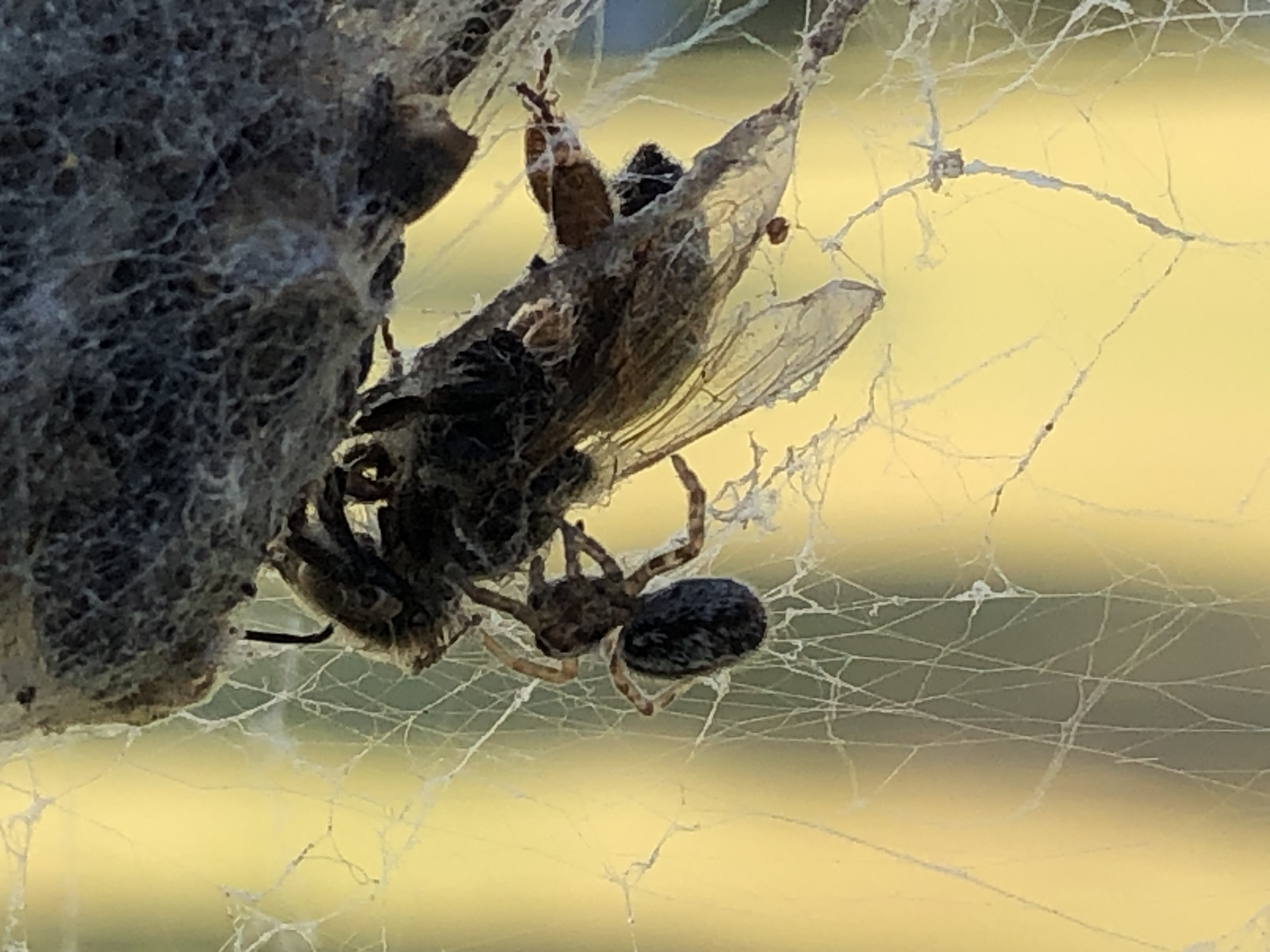
| The delicate spoon-winged lacewing, Halterina purcelli was first discovered on Bergvliet farm by Frederick Purcell. |
|
| The delicate spoon-winged lacewing, Halterina purcelli was first discovered on Bergvliet farm by Frederick Purcell. |

Cape Porcupines (Hystrix africaeaustralis) are nocturnal rodents, the largest rodents in southern Africa. They are occasional visitors to Meadowridge Common where they forage at night for bulbs, corms and tubers (the nutrient-packed underground storage organs of plants). During the day they shelter in burrows or caves on the slopes of Table Mountain, visiting the suburbs and farmlands at night, often finding their way through stormwater drains and along road culverts. They usually forage alone or in small family groups, communicating with high pitched calls, grunts and quill rattling. On average, they live for about 10 years in the wild, raising one litter of up to three young each year.
Porcupines are covered in coarse, long, black hair interspersed with cylindrical, needle-sharp, black-and-white quills that grow up to 30 cm long on the sides of the porcupine. There is a crest of longer, thinner, more flexible spines that runs from the head down its back. Their quills are modified hairs and will grow back if they fall out. They normally lie flat but can be rapidly erected, making the porcupine appear twice its normal size. If this display doesn’t deter its assailant, the porcupine can charge backwards and sideways and drive home its quills which are easily detachable. They cannot shoot their quills.
You may find evidence of porcupine activity on the Common. Sometimes their footprints can be seen in damp sand, or you will find a discarded black-and-white quill, or a few characteristic lumpy fibrous droppings. They leave distinctive funnel-shaped “foraging pits”, and discarded pieces of the bulbs they dig up. Their enthusiastic digging traps water and organic matter, and facilitates the germination and distribution of seeds and bulbils (small, asexual reproductive structures on many bulbous plants). They are thus important ecosystem engineers in the fynbos.
The bulbs of members of the Iridaceae family such as Watsonia, Babiana, Moraea and Romulea are their staple food source in the fynbos, as are the tubers of the arum (Zantedeschia aethiopica). Porcupines have remarkable defences against the toxins contained in some bulbs, like the Cape Tulip (Moraea collina) which is deadly poisonous to humans and domestic livestock if eaten. The bulbs contain cardiac glycosides that disrupt the cardiovascular, nervous and gastrointestinal systems of most animals. Somehow the digestive systems of the porcupines (and mole-rats too) can neutralize toxins. They can also cope with the microscopic, needle-like calcium oxalate crystals in arums that cause pain, swelling and choking in other animals.


They have lots of very small pointy teeth, typical of mammals that eat insects. Despite similarities in looks, they are not related to the moles of Europe and America. Cape Golden Moles occur only in the southwestern and southern Cape, and thrive in the dry sandy soils of the fynbos.
They measure up to 8 cm in body length, with dense, sleek coats that are iridescent in the light. Males and females are the same size. Unlike most mammals, they have a cloaca, a common opening for both reproductive and urinary systems, and therefore have no external copulatory organs.
Cape Golden Moles are infamous among gardeners for their extensive subsurface runs which they excavate with their specialized forelimbs and conical nose shield (rhinarium) in search of earthworms, insects and other soil invertebrates; relying on their acute hearing to locate them. They also dig deeper permanent burrows for sleeping, defecating and breeding. They are solitary, breeding throughout the year, and giving birth to one to three young. Their main predators are owls, cats and dogs.
These moles prey on insects, many of which are harmful to plants and animals. They also enrich and aerate the soil.

The Four-strped Fieldmouse (Rhabdomys pumilio), or Cape Fieldmouse, is found throughout southern Africa. The four stripes running down its back, and red-brown ears, are its distinctive characteristics. It is active in the day, unlike most mice, and is the mouse you are most likely to see here. It mostly eats seeds and grass and some flowers like vygies and proteas. These fieldmice are important seed dispersers in the fynbos, as they bury more seeds than they can eat. The uneaten seeds are thus stored safely underground, away from fire and other predators, until it is time for them to germinate. This is known as “scatter hoarding”.
Fieldmice and other rodents are also key pollinators of many fynbos plants as they feed on the flowers, and inadvertently carry pollen on their heads, to be rubbed off on other flowers, thereby effecting fertilization.
The fieldmice nest in underground burrows, lined with soft vegetable debris, with entrances at the base of clumps of grass. They also construct round nests above ground, hidden in clumps of grass with a single entrance. In the fynbos, one to three young are born in summer.
They are also prey for key fynbos animals such as diurnal raptors, snakes, mongooses, foxes and caracals.

Cape Mole-rats (Georychus capensis) are rodents. Look at the shape of the teeth: four huge incisors typical of the rodent family. Like most rodents, they are plant eaters, burrowing through the sand in search of bulbs, corms and tubers. They excavate nesting, food storage and latrine chambers, creating the mounds of sand you can see on the Common. They use their teeth to dig, unlike the golden moles who use their feet. Their lips close sideways behind their incisors to prevent them swallowing sand.
Cape Mole-rats (at 16 cm in body length) are smaller than the Cape Dune Mole-rat (Bathyergus suillus) which can measure up to 35 cm in length and also occurs near the Common. The Cape Mole-rat has characteristic white markings on its head.
Cape Mole-rats are are solitary and territorial. They give birth to three to ten young in spring. They are preyed on by snakes and, if they venture above ground, by owls, herons, dogs and cats. Although their eyesight is poor, they turn on their attackers baring their teeth aggressively.
Their digging activities enrich the soil by adding nitrogen and magnesium, provide refuges for other species, for example to escape fire, and limit surface runoff of water by loosening the soil and increasing drainage and moisture holding capacity.
 |

The Friends of Meadowridge Common present a talk on
The Birds of the Pharaohs
by John Lombard: an illustrated talk that combines Egyptology and bird migration, both great interests of John’s. Egyptian tombs display 72 different birds, many of which we are familiar with in South Africa.
Join us at 6.30 pm on Thursday 28 November at the Meadowridge Library, Howard Drive to find out more about why the Egyptians were so aware of birds.
The talk will last an hour and secure parking is provided. Everyone is welcome and there is no entrance fee. Refreshments will follow the talk.

So bring your kids or dogs (and poo bags) - and have a walk on the common. Don't forget to visit our fantastic new Cape Flats Sand Fynbos Circle. Take note of the birds, plants and goggas, and if you feel inspired, photograph some and upload them on iNaturalist to make a contribution to the study and monitoring of our amazing biodiversity.

The award was made at a WESSA function hosted by Beaumont Primary School in Somerset West on Saturday 16 March. Despite the keynote speaker from the Western Cape Dept. of Education not putting in an appearance, it was a most enjoyable and well attended ceremony and the guests and recipients of the awards (mostly eco-school awards) were treated to a tour of Beaumont Primary which has the most fantastic eco-programme which permeates everything the pupils do.


 |
Fire, fynbos, fauna and flora - its all in the latest newsletter compiled by the Chairperson of the Friends. Click on the link below to read all about what it happening on the Common.
And save the date for our AGM on Tuesday 5 March in the the Meadowridge Library Hall at 18h00. There will be a talk on the recent wildfires in the Cape: the causes, how to fight them and how training is conducted, by Rob Erasmus.

On Thursday 29 Feb, the Friends will be hosting a weeding session on our new Cape Flats Sand Fynbos Circle on Meadowridge Common. This FynbosLIFE restoration circle was planted last year and has survived floods and burning heat since then. Bulbs came up and flowered (and hopefully set some seed), and many of the seedlings are hanging in there, waiting for the cooler, wetter days of Autumn in order to start growing. Some are already flowering, like the rough blue sage (Salvia chamelaeagnea) and twocolour brightfig (Lampranthus bicolor). We need to keep the area free of invasive kikuyu grass and other weeds, and urgently require help from local residents and Friends. Anyone is welcome to join us, just bring a trowel and a hat; and some water as it is hot work. We welcome moral support too! Tea and biscuits will be provided.
For more information, please email Caroline or Roger at MeadowridgeFriends@gmail.com.

Join the Friends of Meadowridge Common to hear Dr Caitlin von Witt of FynbosLIFE talk about the new Sand Fynbos Circle on Meadowridge Common. Caitlin propagated fynbos plants from the Common and grew them on in the FynbosLIFE nursery until they were ready to be planted out on a specially prepared area of the Common which had become badly degraded. Now the Circle is ready to be introduced to the world - and you are invited to come and hear all about our precious Sand Fynbos and how this creative project will uplift not only the Common and the local community, but biodiversity in general.
The Friends are responsible for the upkeep of the Circle and will be needing all the help they can get from the community, especially the weeding out of invasive kikuyu grass. There are also workshops and environmental educational activities planned for the new year, so bring the family and come and hear more about the Cape Flats Sand Fynbos Circle on Monday 11 December.
Date: Monday 11 December
Time: 18h00
Venue: The parking area off Faraday Road, near the Football Club buildings.
Free entry.
For more information, contact Roger at 021 715 9206, email the Friends on Meadowridgefriend@gmail.com, visit our website at MeadowridgeCommon.blogspot.com, or search for The Friends of Meadowridge Common on Instagram or Facebook.

Our new Cape Flats Sand Fynbos rehabilitation circle, designed and planted by FynbosLIFE with funding from the Rowland and Leta Hill Fund, is the first phase of a project to restore the natural fynbos on Meadowridge Common by removing invasive grass and weeds and allowing the indigenous flora and fauna to return. It is hoped that this will help conserve this critically endangered fynbos type, and also promote the use of the Common as a safe place for educational and recreational activities. The Friends of Meadowridge Common, who are overseeing the project, urgently need assistance with the maintenance of the rehabilitation circle, especially with weeding invasive kikuyu grass. The Friends will be hosting weeding sessions on selected days, and will be there to supervise weeders who would like to volunteer an hour of their time to assist. Any level of fitness is enough – even if you turn up just to see what is happening on the Common.
If you would like to participate, please send your email address and/or telephone number to The Friends of Meadowridge Common at Meadowridgefriend@gmail.com and they will let you know dates and times. We will also put notices on our social media pages and on the Friends website, http://MeadowridgeCommon.blogspot.com. Or just turn up on the next weeding day with a trowel.
The next weeding sessions is on Thursday 23 November from 9h00–10h00.


 |
 |
Roger Graham (Chairperson of the Friends of Meadowridge
Common), Caitlin von Witt (Managing Director of FynbosLIFE), Sihle Jonas and
Luyanda Mjuleni (both from the City of Cape Town Parks and Recreation
Department.) |
 |
| Dr Caitlin von Witt. Photo: FynbosLife. |
 |
 |
 |
 |
|
|
|
|
|
|


.jpg)